TLDR
Modern digital cockpits operate as complex distributed systems, yet conventional testing often remains stuck in isolation, focusing on individual displays and failing to capture critical integration bugs like time desync and logic mismatches. To overcome this, engineering teams must adopt cross-layer verification that validates the underlying API layer and the top-level UI simultaneously.
AskUI enables this cross-layer verification through multi-agent orchestration, coordinating agentic computer use agents to synchronize and audit multiple virtual displays, such as the Cluster and CID, within a SIL (Software-in-the-Loop) environment. This allows teams to verify that a single API trigger produces a consistent, time-aligned response across multiple software components.
1. The Fragmentation Trap: Why Isolated Testing Fails
In the era of Software-Defined Vehicles (SDV), the cockpit is a sophisticated, distributed architecture. While testing individual displays ensures isolated functionality, it often fails to capture integration-level time desync.
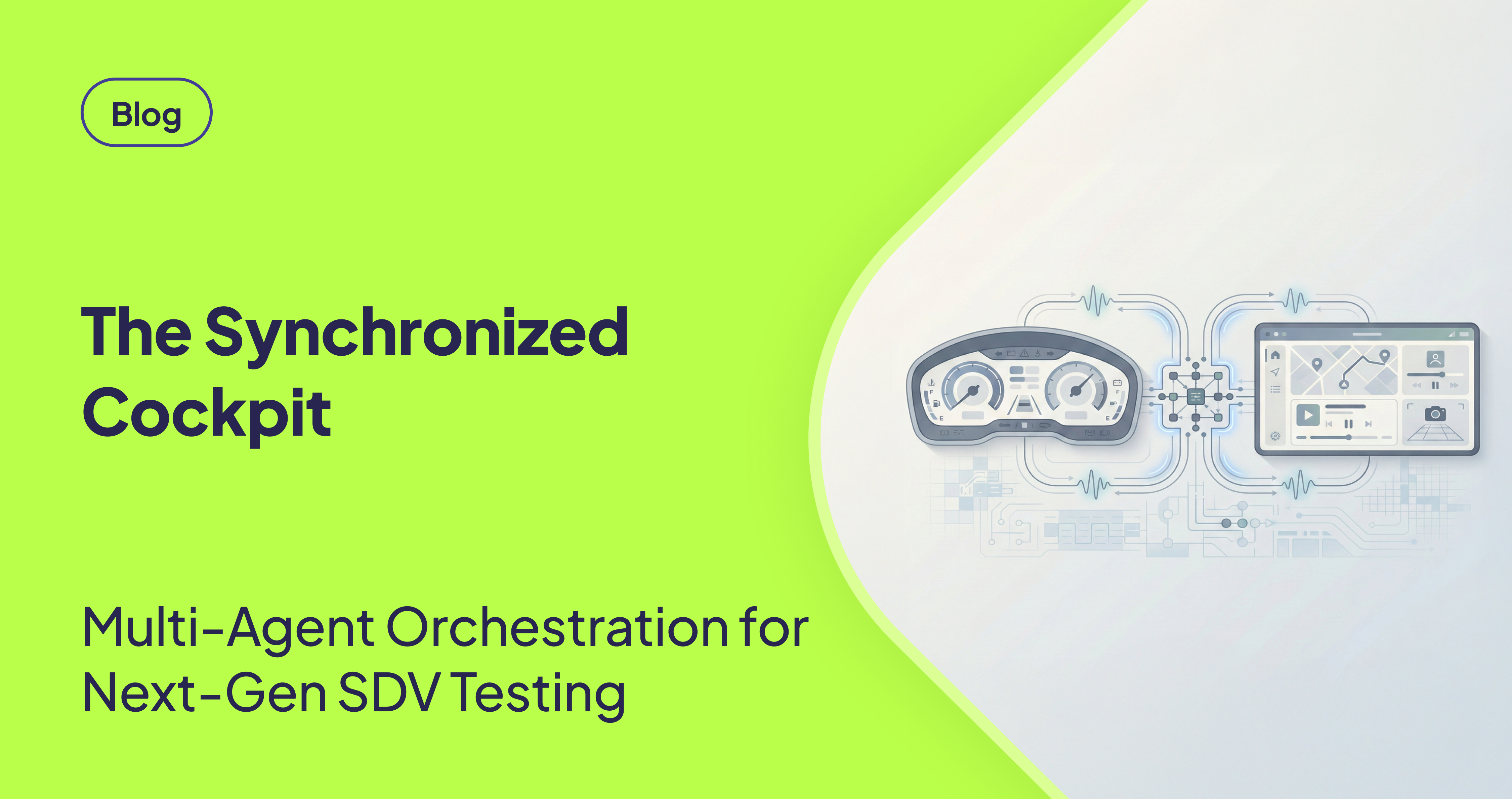
A common failure mode involves high-priority events, such as an Emergency Braking alert that must trigger a warning icon on the Cluster and 360° camera view on the CID simultaneously. Even when these triggers are successfully dispatched at the API or middleware layer, the resulting visual outputs can exhibit latency or jitter due to conflicting processing priorities or network bottlenecks within the HMI architecture. Without a unified testing view, these discrepancies frequently go undetected until late-stage integration, leading to costly and complex regression cycles.
2. Cross-layer Verification: Bridging API and UI
To achieve end-to-end system determinism, verification must move beyond pixels on a screen to cover the entire logic flow. Cross-layer verification bridges the gap by tracing the entire lifecycle of the system event , from the moment its initial API is dispatched to the final visual rendering across all displays.
By cross-checking the consistency between the bottom-level system state and the top-level UI output, teams can detect state-view inconsistency early in the SIL stage. This approach confirms that the system is precisely aligned, allowing engineers to prove that the system intent sent via API matches the visualized state on the screen, long before the software ever touches a physical hardware.
3. Engineering Precision: Multi-Agent Orchestration
Assessing multiple interfaces in parallel within a virtual environment requires a level of coordination that traditional automation cannot provide. AskUI addresses this through a robust multi-agent framework driven by agentic AI.
-
Orchestrated AI Agents: Instead of a single script, computer use agents are deployed to dedicated displays. These agents are coordinated under a single task to calculate timing differences and cross-display behavior in real-time.
-
Agent Reasoning: These agents understand UI context and functional intent. They do not rely on fixed coordinates, they interact with the HMI as a human would, making them resilient to layout changes or platform migrations during rapid development cycles.
-
Rigorous Synchronization Audit: The agents confirm that a single system-wide trigger results in a unified reaction across all displays within the required tolerance window, providing objective data on overall temporal consistency.
4. Proving Cockpit Consistency in SIL
The primary value of this agentic approach lies in its ability to harden the software infrastructure during the SIL phase. By focusing on the integrity of the software logic and UI consistency, AskUI’s agentic AI enables teams to iterate with high precision without being bottlenecked by hardware availability or physical interface constraints like CAN bus.
Operating within an enterprise-grade infrastructure that adheres to global security standards(ISO 27001), these computer use agents can run across various virtualized environments. By adopting intent-driven, orchestrated testing, SDV manufacturers can establish a high-fidelity virtual proving ground, enabling the digital cockpit to function as a single cohesive system that is ready for the road.
FAQ
Q: How can a single script control and verify multiple displays simultaneously?
A: AskUI allows you to initialize and manage multiple agent instances within a single orchestration script. By assigning dedicated agents to individual interfaces like Cluster and CID and coordinating them through parallel workflow, you can synchronized their action and audit complex cross-display logic in real-time. This allows interdependent system behaviors to be validated.
Q: Is AskUI is effective in early-stage development where the UI layout changes?
A: Yes. Unlike traditional automation tools that rely on brittle coordinates or underlying source code, AskUI’s agentic AI understands visual context and functional intent. Because the agents see and interact with HMI just like human. They automatically adapt to shifted elements or minor design updates. This significantly reduces maintenance overhead and allows testing to remain stable during fast development cycles.
Q: Can synchronization latency between displays be measured with high precision?
A: Each agent captures timestamps in milliseconds at the exact moment a visual change is detected. By cross referencing these logs with the initial API trigger, you can objectively operate under identical conditions, allowing for an accurate calculation of the relative delta(the time difference between displays). This provides definitive data to prove that the system functions within the required tolerance window.